The celestial sphere is a tool that astronomers use to map the sky. To navigate the map, we need coordinates. Maps of the Earth have longitude and latitude; the celestial sphere has right ascension (RA) and declination (Dec). To make sense of longitude and latitude, you first need to locate the North and South Poles. … Continue reading Celestial Coordinates
Astronomy 111
Celestial Sphere
Astronomers map the sky. Maps of the sky have aided navigators for thousands of years. They also let astronomers locate and identify astronomical objects such as stars, nebulae, and galaxies and plan astronomical observations. Backyard astronomers use sky atlases (likely digital) to find interesting objects in the sky. Professional astronomers map the sky so that … Continue reading Celestial Sphere
Confidence
Confidence is a tricky concept, but it's also a pragmatic one. We can never be 100% sure of anything, but we still need to get on with the business of living our lives. There are bridges and airplanes and smartphones to build, and they all rely our current scientific theories. We don't have certainty that … Continue reading Confidence
Falsifiability
You may have learned in a previous science class that scientific hypotheses must make testable predictions. A less simplified statement is that scientific hypotheses must be falsifiable. Falsifiability is a cornerstone of science. Start by reading the entry on the Criterion of falsifiability from Encyclopedia Britannica. I like to simplify the definition of falsifiable by … Continue reading Falsifiability
The Scientific Method
It is a common misconception that the scientific method is series of steps that scientists use to prove a hypothesis either correct or incorrect. Imagine a common junior high science project. Two near-identical plants are planted in identical soil under identical light. One is watered daily, one is not. The one that is watered thrives, … Continue reading The Scientific Method
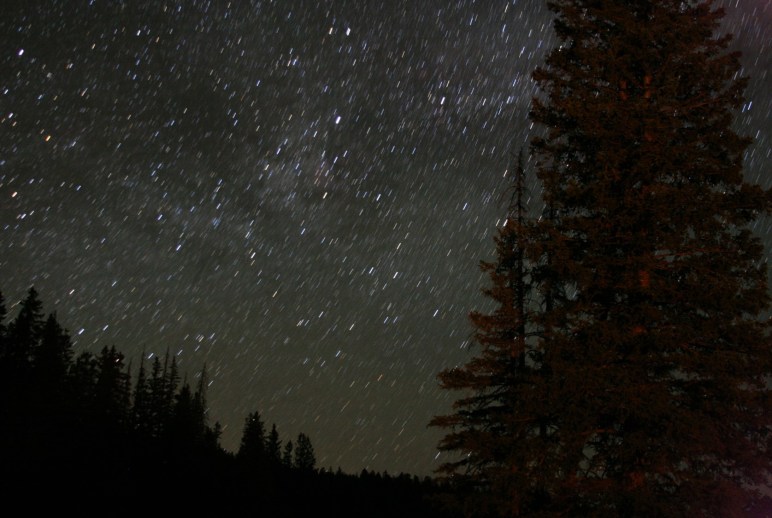
What is moving? The Stars or the Earth?
Stars appear to rotate around a point in the upper left corner of this time lapse image taken from a campsite in Arizona's White Mountains. You probably know that astronomers in Ancient Greece thought that the stars spun around a fixed, immovable Earth, but that we now know that the Earth moves - rotating around … Continue reading What is moving? The Stars or the Earth?
 Blog for Astronomy Courses